

Natural Alternatives to Chemical Fabric Softeners
Table of Contents
- Why Chemical Fabric Softeners Might Not Be Ideal for Your Laundry
- White Vinegar in Laundry: A Natural Fabric Softener That Works
- Wool Dryer Balls: Reusable Softness Without Chemicals
- Baking Soda and Epsom Salt: Simple Additions for Softer Clothes
- Homemade Fabric Softener Without Conditioner: Easy Recipes
- Fabric Softener for Delicate Clothes: What to Use Instead
- How to Choose the Right Natural Fabric Softener for Your Needs
- Conclusion: Soft, Fresh Laundry Without the Chemicals
- Frequently Asked Questions
Last Updated: October 17, 2026
Why Chemical Fabric Softeners Might Not Be Ideal for Your Laundry
Natural alternatives to chemical fabric softeners have moved into mainstream laundry rooms. Conventional softeners coat fibers in synthetic chemicals, delivering short-term softness while building up residue that dulls colors and reduces absorbency, especially on delicates. This guide from Lingeriemagic covers the substitutes that work, how to use them, and where they fall short.
The core issue is buildup. Over repeated washes, the coating traps detergent residue and minerals from hard water inside the fabric rather than rinsing away. Towels stop absorbing, workout wear holds onto odor, and lace loses its crispness. EPA guidance on safer household cleaning ingredients notes that ingredient transparency varies widely across laundry products, which makes it hard to know exactly what is coating your clothes. A common mistake is assuming "soft" means "clean." It does not.
Below, the practical options are broken down by how they work, what fabrics they suit, and what to watch for.
White Vinegar in Laundry: A Natural Fabric Softener That Works
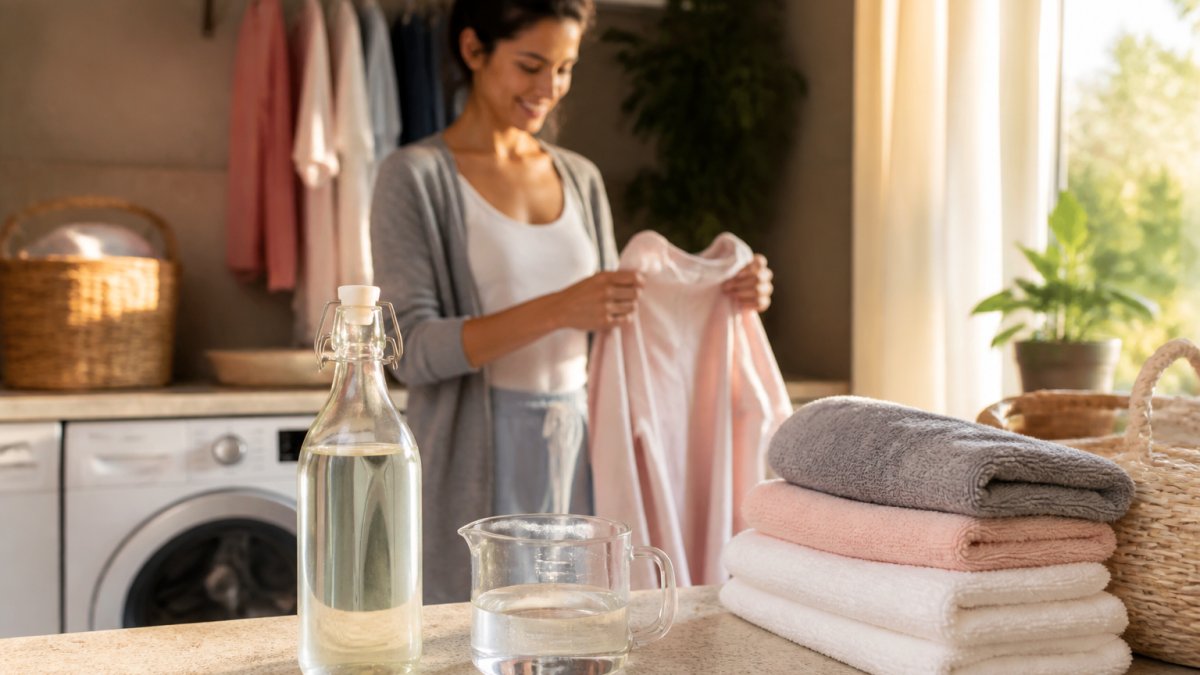
White vinegar in laundry is the closest thing to a universal natural softener. Its mild acidity dissolves detergent and mineral residue in the fibers, which is what makes clothes feel softer after drying. It also deodorizes without leaving a scent.
Use half a cup per laundry load. Pour it into the fabric softener compartment of the washing machine, or add it during the rinse cycle if the machine does not have one. Skip it on the wash cycle, where it is less effective.
A few things most guides get wrong:
- Do not mix vinegar directly with bleach in the same load. It can release irritating fumes.
- Vinegar is safe for cotton, linen, and most synthetics, but repeated use on elastic-heavy garments can stress the rubber over time.
- It will not eliminate static cling on its own in very dry conditions.
For static, pair vinegar with wool dryer balls rather than adding more product. That combination handles both softness and cling without fragrance.
Wool Dryer Balls: Reusable Softness Without Chemicals
Wool dryer balls are the simplest swap for dryer sheets. They bounce between garments, separating fabrics so air circulates better, cutting drying time and reducing static through friction rather than coating. A set lasts hundreds of loads before the wool compacts.
They are fragrance-free by default, which matters for skin sensitivity. A drop or two of essential oils adds scent without a sheet's chemical load, though overuse can leave faint marks on light fabrics.
Performance and care are where competitors tend to gloss over the details:
| Factor | What to Expect | Care Note |
|---|---|---|
| Static reduction | Moderate to good in most loads | Add a third or fourth ball for large loads |
| Drying time | Noticeably shorter | Do not overload the dryer |
| Scent | None unless oils added | Re-oil every few loads, not every load |
| Lifespan | Long, but not indefinite | Retire when the wool stops bouncing |
The one drawback: dryer balls do nothing for softness in the wash itself. If clothes go into the dryer stiff, they come out stiff. Pair them with vinegar in the rinse for the best result.
Baking Soda and Epsom Salt: Simple Additions for Softer Clothes
Baking soda and Epsom salt are often lumped together as "natural softeners," but they work differently and suit different laundry problems.
Baking soda (sodium bicarbonate) is a mild alkali that softens water by precipitating calcium and magnesium ions, the minerals that make water "hard." With those minerals tied up, detergent works instead of fighting the water, so less residue remains on fabric. Add half a cup to the wash cycle with your regular detergent, especially useful in hard water.
Baking soda is safe for cotton, linen, and synthetics. Avoid it on silk and wool, protein fibers sensitive to alkaline solutions; repeated use can dull sheen and weaken fibers. It is not a softener in the traditional sense, it adds no slip and reduces no static. Think of it as a water conditioner that indirectly improves softness.
Epsom salt (magnesium sulfate) works differently. Dissolved in the rinse, it relaxes stiff cotton and linen fibers by interfering with the hydrogen bonds that cause stiffness during drying. Use about two tablespoons, dissolved first in warm water. Unlike baking soda, it does not soften water, it adds magnesium, already a hardness mineral, so in very hard water it may make things worse unless the load is well-rinsed.
Epsom salt is best for soft-water households or occasional treatment of stiff towels and denim. It is not suitable for elastic-heavy garments, as magnesium degrades rubber, and never for flame-resistant clothing, where mineral residue compromises protection.
Neither baking soda nor Epsom salt is a true softening agent the way vinegar is. Vinegar works on residue already in the fabric; baking soda prevents new residue; Epsom salt relaxes fibers temporarily. In soft water, both offer minimal benefit; in hard water, baking soda in the wash is more reliable. For a complete routine, pair baking soda in the wash with vinegar in the rinse, they address different stages and do not cancel each other out when used separately.
A common mistake is mixing baking soda and vinegar in the same compartment. They react to form water, salt, and carbon dioxide, neutralizing both before they reach the fabric. Use separate cycles.
Homemade Fabric Softener Without Conditioner: Easy Recipes
Homemade fabric softener without conditioner is entirely possible, and it avoids the heavy perfumes and silicones in store-bought versions. The simplest recipe needs two ingredients.
Basic vinegar softener:
- 1 cup white vinegar
- 1 cup water
- Optional: 8 to 10 drops essential oil
Combine in a bottle, shake before each use, and add half a cup to the fabric softener compartment.
Baking soda booster:
- 1/2 cup baking soda
- 4 cups warm water
Stir until fully dissolved. Add one cup to the rinse cycle for hard-water loads.
A note on the popular hair conditioner method: conditioner is itself a chemical product, so it defeats the purpose of going natural and leaves the same residue conventional softeners do. Skip it if chemical-free is the goal.
Store homemade mixes in a labeled bottle away from heat. Vinegar solutions keep indefinitely; baking soda solutions are best mixed fresh.
Fabric Softener for Delicate Clothes: What to Use Instead
Delicate fabrics are where natural softeners can shine or cause damage, depending on the fiber.
Silk and wool are protein fibers sensitive to alkaline substances, so avoid baking soda and Epsom salt, they dull sheen and weaken fibers.
Lace and mesh are structure-sensitive. Any friction, dryer balls or a crowded dryer, can pull threads and distort patterns. The safest approach is a plain cool rinse with no additives, then flat drying on a towel.
Cotton and linen tolerate vinegar, baking soda, and dryer balls well. For towels, avoid any softener that leaves a coating, conventional or oil-based natural, because coatings reduce absorbency.
Athletic wear and microfiber are engineered fabrics that rely on capillary action to wick moisture; any softener, natural or chemical, clogs the spaces between fibers and destroys performance. Skip all softeners, including large amounts of vinegar.
Flame-resistant clothing (FR) is a safety category. Softeners of any kind, including natural alternatives, can leave flammable residue or compromise protective chemicals. Follow the manufacturer's care instructions, typically no softeners, dryer sheets, or fabric conditioners.
Synthetics like polyester and nylon are generally safe with vinegar and dryer balls. Essential oils, however, can stain light-colored synthetics and leave an oily residue that attracts lint.
| Fabric | Best Natural Option | Avoid |
|---|---|---|
| Cotton | Vinegar rinse plus dryer balls | Overdosing vinegar |
| Linen | Vinegar rinse, air dry | High dryer heat |
| Silk | Plain cool rinse, air dry | Baking soda, dryer balls, Epsom salt |
| Wool | Plain cool rinse, air dry | Baking soda, Epsom salt, dryer balls |
| Lace and mesh | Plain cool rinse, flat dry | Any friction or oil |
| Athletic wear | Plain wash, no softener | All softeners, essential oils |
| Microfiber | Plain wash, no softener | All softeners, dryer sheets |
| Flame-resistant | Follow manufacturer instructions | All softeners, vinegar unless approved |
| Synthetics | Vinegar plus dryer balls | Essential oils on light colors |
Hard water complicates delicate care: detergent residue and minerals can make even a gentle rinse feel stiff. For delicates, use baking soda in the wash cycle, but only for cotton and linen, not silk or wool.
Skin sensitivity is another factor. Fragrance-free is the default for delicates, but watch for hidden irritants in "natural" products. Essential oils, even therapeutic grade, can cause contact dermatitis.
The same principles apply whether the garment is everyday wear or reserved for special occasions.
How to Choose the Right Natural Fabric Softener for Your Needs
Choosing comes down to three questions: what is your water like, what fabrics dominate your load, and do you need scent or static control. Answer those and the decision is straightforward.
- Hard water: Start with baking soda in the wash and vinegar in the rinse.
- Soft water: Vinegar alone is usually enough.
- Static-prone loads: Wool dryer balls, with a third ball for large loads.
- Skin sensitivity: Stick to fragrance-free options and skip essential oils.
- Delicates: Plain cool rinse and air drying, no additives.
- Septic systems: Vinegar and baking soda in normal amounts are generally fine; avoid heavy additive use.
Cost matters too. Vinegar and baking soda are among the cheapest household ingredients, and wool dryer balls replace repeat dryer-sheet purchases, so the switch tends to save money over a year.
Conclusion: Soft, Fresh Laundry Without the Chemicals
The switch away from chemical softeners is less about deprivation than matching the right tool to the right fabric. Vinegar handles residue and odor, baking soda tackles hard water, and wool dryer balls manage static and drying time. Used together, they cover nearly every load without the buildup that dulls colors and traps odor, results that show up over months, not one wash.
For intimate apparel and sleepwear, that same care pays off. Lingeriemagic offers a curated selection of high-quality lingerie and sleepwear built to last, with an inclusive range of sizes and styles for everyday comfort. A gentle, chemical-free wash routine helps those pieces stay comfortable and true to form far longer.
Continue Shopping with Lingeriemagic and give your wardrobe the care it deserves.
Frequently Asked Questions
What can I use in my washing machine instead of fabric softener?
You can use white vinegar in the fabric softener compartment, wool dryer balls in the dryer, or add half a cup of baking soda to the wash cycle. These natural alternatives soften fabrics, reduce static cling, and avoid the residue that chemical softeners leave behind. For delicate items, vinegar is especially gentle and helps maintain fabric integrity.
Can white vinegar replace fabric softener in the washing machine?
Yes, white vinegar works as a natural fabric softener. Pour half a cup into the fabric softener dispenser or add it during the rinse cycle. It softens clothes, deodorizes, and helps remove detergent residue without leaving a vinegar smell. It is safe for most fabrics, but avoid using it on elastic or delicate lace frequently, as acid can degrade those materials over time.
Are wool dryer balls a good alternative to fabric softener?
Wool dryer balls are an excellent alternative. They lift and separate clothes in the dryer, reducing drying time and static cling. They contain no chemicals or fragrances, making them ideal for sensitive skin. For best results, use three to six balls per load. Recharge them occasionally by washing in hot water or adding a few drops of essential oil for a light scent.
Can fabric softener damage lace lingerie or elastic?
Yes, chemical fabric softeners can damage lace and elastic over time. The coating they leave behind can break down fibers, reduce stretch, and cause yellowing. For delicate lingerie, skip fabric softener entirely. Instead, hand wash with a gentle detergent and add a small amount of white vinegar to the rinse water to keep fabrics soft and residue-free.
Why Silk Lingerie Is Better for Your Skin: A 2026 Guide
Cosabella vs Bluebella: Lingerie Review 2026
Related Posts

Cosabella vs Bluebella: Lingerie Review 2026

Why Silk Lingerie Is Better for Your Skin: A 2026 Guide

How to Find Bra Size Without a Tape Measure

Tips for Buying Lingerie as Gifts: A 2026 Guide

How to Remove Stains from Silk Lingerie Safely

Is Wireless Lingerie Worth It for Everyday Wear?
