

How to Find Bra Size Without a Tape Measure
Table of Contents
- Why You Can Find Your Bra Size Without a Tape Measure
- How to Tell If a Bra Fits Properly: The 5-Point Check
- Using a Current Bra as Your Starting Point
- Bra Band Size Guide: Estimating Your Band Without a Tape
- Bra Cup Size Guide: Reading Cup Fit and Coverage
- Sister Sizes in Bras: When to Size Up or Down
- Common Fit Symptoms and How to Troubleshoot Them
- How Accurate Is a Tape-Free Bra Size Estimate?
- Frequently Asked Questions
Last Updated: October 14, 2026
Why You Can Find Your Bra Size Without a Tape Measure
You don't need a tape measure to find your bra size. You need a bra that already fits, a mirror, and about ten minutes. Learning how to find bra size without tape measure is really a lesson in reading fit signals, not numbers.
Here's the problem with tape measures: they lie. A tape gives you a number, but it can't tell you how a band grips or where a cup digs in. A fit check can.
This guide from Lingeriemagic walks through the whole process. You'll learn the five-point fit check, how to convert your current bra into a starting size, and how to troubleshoot the most common fit problems.
When a Fit Check Beats a Measurement
Fit checks beat measurements in one clear case: when you already own a bra. A bra that almost fits tells you more than any tape ever could.
It shows you where the band sits, where the cups gap, and how the straps behave. Those signals point straight to your real size.
Measurements still matter for first-time buyers. But for anyone with a drawer full of bras, a fit check is faster and more accurate.
How to Tell If a Bra Fits Properly: The 5-Point Check
To tell if a bra fits properly, check five points: band, cups, underwire, center gore, and straps. If all five pass, the size is right. If any fail, adjust that area first.
Here is the full check:
- Band - sits level and snug, not riding up
- Cups - smooth, no spillage or gaping
- Underwire - lies flat against the ribcage
- Center gore - touches the breastbone
- Straps - stay put without digging in
Run through this list in front of a mirror. Note which points fail.
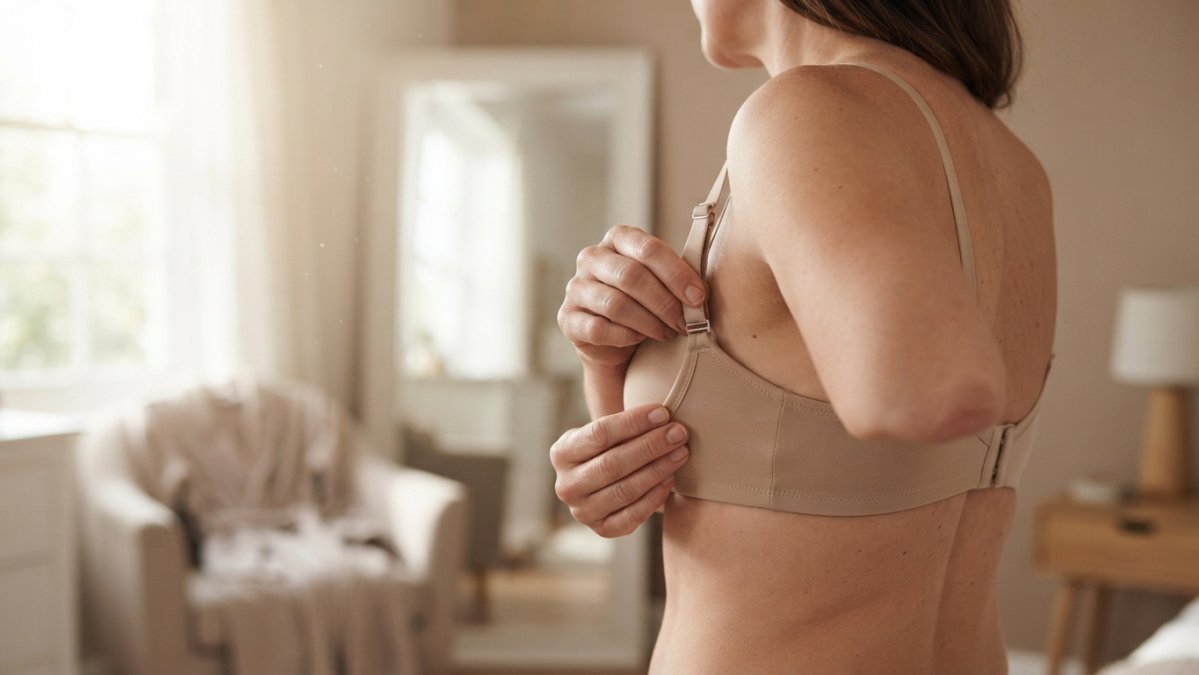
Checking Band Fit and Comfort
A good band stays level all the way around. It should feel snug but never painful.
Try this test: hook the bra on the loosest setting and see if you can slide two fingers under the band. If you can, the band is too loose. If you can't breathe, it's too tight.
A band that rides up in back is too loose. A band that leaves red marks is too tight. Both mean the band size is off.
Checking Cup Fit and Coverage
Cups should hold everything without cutting in or leaving space. Run a finger along the top edge.
- Spillage over the top means the cup is too small
- Gaping at the top means the cup is too big
- Wrinkling in the fabric means the cup shape is wrong
Cup fit changes with style. A balconette and a full-coverage bra can fit the same body differently.
Using a Current Bra as Your Starting Point
Your current bra is the best starting point for a tape-free size estimate. Read the tag, then judge how it actually fits.
Check the band and cup size on the label. Now ask three questions:
- Does the band ride up? Size down in the band
- Do the cups spill? Size up in the cup
- Do the cups gap? Size down in the cup
Write down your adjusted size. That's your new starting point.
Bra Band Size Guide: Estimating Your Band Without a Tape
A bra band size guide without a tape works by feel, not inches. Your band size is the number that keeps the band level and snug.
Test it three ways:
- The band stays level in back
- Two fingers fit under the band, no more
- The band doesn't leave deep marks
If the band passes all three, that number is your band size. If it fails, adjust by one size and retest.
Using a Non-Stretch Substitute Safely
A non-stretch substitute works when you have nothing else. Good options include non-stretch string, a phone cord, a robe sash, or a soft belt.
Here's how to use one safely:
- Wrap the substitute around your ribcage, just under the bust
- Keep it level and snug, not tight
- Mark where the ends meet
- Lay it flat against a ruler to read the length
- Round to the nearest whole number
Avoid anything stretchy. Elastic stretches as you pull, so the number you read will be too small.
guidance on how to measure at home from a national health service
Bra Cup Size Guide: Reading Cup Fit and Coverage
A bra cup size guide without a tape reads the cup by how it holds, not by a number. Cup size is the difference between your band and your bust.
Since you can't measure that difference directly, use fit signals instead:
| Cup Signal | What It Means | What to Do |
|---|---|---|
| Spillage over the top | Cup too small | Go up one cup |
| Gaping at the top | Cup too big | Go down one cup |
| Wrinkled fabric | Wrong cup shape | Try a different style |
| Underwire digging in | Cup too small | Go up one cup |
| Smooth, full coverage | Correct fit | Keep this size |
Cup fit also depends on style and brand. A cup that fits in one brand may not fit in another.
Sister Sizes in Bras: When to Size Up or Down
Sister sizes in bras are sizes that hold the same cup volume on a different band. When you change the band, you change the cup letter to keep the volume the same.
The rule is simple: go down a band, go up a cup. Or go up a band, go down a cup.
Examples:
- 34C and 32D are sister sizes
- 36B and 34C are sister sizes
- 38D and 36DD are sister sizes
Use sister sizes when a band feels tight but the cup volume is right. Try the sister size before giving up on the style.
Common Fit Symptoms and How to Troubleshoot Them
Most fit problems trace back to one of four causes. Match the symptom to the fix.
| Symptom | Likely Cause | Fix |
|---|---|---|
| Band riding up | Band too loose | Size down in the band |
| Cup spillage | Cup too small | Size up in the cup |
| Cup gaping | Cup too big or wrong shape | Size down or change style |
| Straps digging in | Straps too tight | Loosen straps, check band |
| Underwire poking | Cup too small | Size up in the cup |
| Center gore floating | Band too big | Size down in the band |
Work through one symptom at a time. Fixing the band often fixes the cups too.
How Accurate Is a Tape-Free Bra Size Estimate?
A tape-free estimate is a starting point, not a final answer. It gets you close, but it can't replace a proper try-on. The accuracy depends on the method you use and how well you read fit signals.
Here's a simple decision tree to gauge your confidence:
- If you used a non-stretch substitute and measured carefully, your band estimate is likely within one size.
- If you relied only on a current bra's tag and fit adjustments, your estimate is a rough guide, often off by one band or cup size.
- If you guessed based on how a bra feels without any measurement, treat the result as a hypothesis to test.
Why the variation? Bra sizing is not universal. A 34C in one brand can fit like a 34B in another. Cup shapes differ, band elasticity varies, and styles like balconette or full-coverage change how a size feels. Even within the same brand, a lace bra and a molded cup can fit differently.
A few limits to keep in mind:
- Non-measuring methods are less precise than a tape.
- Fit varies by brand and style.
- Body changes affect fit over time.
So treat your estimate as a first guess. Try that size, then adjust using the five-point check. If the band rides up, size down. If cups spill, size up. If the gore floats, size down in the band. Work through one symptom at a time.
consumer advice on clothing fit and returns from a national consumer body
For the best result, combine your estimate with a real try-on. Lingeriemagic offers an inclusive range of sizes and styles, so you can test your estimate across different fits. The brand's focus on durable construction and everyday comfort means a well-fitted piece stays comfortable wear after wear.
Frequently Asked Questions
Can I estimate my bra size using a bra that fits well?
Yes. Choose a bra that feels comfortable and check the tag for its band and cup size. Fasten it on the loosest hook and note where the band sits, whether the cups lie flat, and if the straps stay put without digging in. If everything checks out, that size is a solid starting point. If the band rides up or the cups gap, adjust one element at a time until the fit improves.
How do I know if I need a different band or cup size?
A band riding up your back usually means the band is too loose, so try one band size smaller. Cup spillage at the top or sides points to a cup that is too small. Cup gaping or wrinkles suggest the cup is too large. Change only one variable at a time, band or cup, and reassess before adjusting again.
Is a 36C the same as a 34D?
They are sister sizes, not identical. A 34D has a smaller band and a larger cup than a 36C, but the cup volume is similar. If a 36C band feels loose but the cups fit well, try a 34D. If a 34D band feels tight but the cups fit, try a 36C. Sister sizing works because cup volume shifts with band size.
How accurate is it to estimate bra size without measuring?
Tape-free methods give a close estimate, not a precise measurement. Fit checks and a well-fitting reference bra can narrow your range to one or two sizes, but brand sizing varies. Treat the result as a starting point, try the bra on, and adjust based on how the band, cups, and straps actually feel.
Finding the right bra size shouldn't feel like guesswork. The five-point fit check, a current bra, and a safe non-stretch substitute can get you close without a tape. When you're ready to test your size for real, Lingeriemagic offers a curated range of lingerie and sleepwear built for comfort and made to last. Explore inclusive sizing, high-quality fabrics, and styles designed for everyday wear. Continue shopping with Lingeriemagic and find the fit that finally feels right.
Tips for Buying Lingerie as Gifts: A 2026 Guide
Why Silk Lingerie Is Better for Your Skin: A 2026 Guide
Related Posts

Why Silk Lingerie Is Better for Your Skin: A 2026 Guide

Tips for Buying Lingerie as Gifts: A 2026 Guide

How to Remove Stains from Silk Lingerie Safely

Is Wireless Lingerie Worth It for Everyday Wear?

Sister Sizing Guide for Beginners Explained

Bare Necessities vs Journelle: Which Retailer Fits You
