

7 Signs Your Bra Does Not Fit Properly
Table of Contents
- 1. The Back Band Rides Up
- 2. Shoulder Straps Dig In or Fall Down
- 3. Cup Spillage or Overflow (Quad-Boob)
- 4. Empty Space or Wrinkling in the Cups
- 5. The Gore Does Not Sit Flat Against Your Chest
- 6. Underwire Pokes, Chafes, or Sits on Breast Tissue
- How to Measure Bra Size at Home
- How to Perform the Scoop and Swoop Method
- Frequently Asked Questions
Last Updated: September 25, 2026
1. The Back Band Rides Up
If your band climbs toward your shoulder blades by mid-day, it is too loose, one of the 7 signs your bra does not fit properly. The back band should sit level with the front, hugging your ribcage without digging in. This is one of the most common signs your bra does not fit properly, and it usually means your band size is too big.
A riding band shifts weight onto your shoulders instead of your ribcage. That is why your straps feel heavy by afternoon. When you raise your arms and the band slides up, the fit is wrong.
Here is why this happens:
- The band has stretched out from wear
- You are wearing a band size that is too large
- The hook-and-eye closure is set too loose
Try fastening the band on the tightest hook. If it still rides up, size down in the band. A snug band does most of the work. Straps should only fine-tune the fit.
2. Shoulder Straps Dig In or Fall Down
Straps that leave red marks or slide off your shoulders point to a size mismatch. The culprit is usually the band, not the straps themselves. A band that is too loose forces straps to carry the weight. A band that is too tight makes straps dig in.
Both problems have the same root: your band size and cup size are not balanced.
Signs to watch for:
- Deep grooves in your shoulders at the end of the day
- Straps that slip off when you move your arms
- Needing to tighten straps constantly
Adjust straps so you can slide one finger underneath. If they still dig in, go up a band size and down a cup size. This is called sister sizing. A 34C becomes a 32D, for example. The cup volume stays the same while the band gets looser.
3. Cup Spillage or Overflow (Quad-Boob)
Breast tissue spilling over the top or sides of your cups means your cup size is too small. This creates the "quad-boob" effect, where four bumps appear instead of two smooth curves. It is uncomfortable and shows under clothing.
Spillage is one of the clearest of the 7 signs your bra does not fit properly. It usually means you need a larger cup, not a larger band.
Check for these signs:
- Tissue bulging above the cup edge
- Bulging under your arms
- Cup edges cutting into your skin
Go up one cup size first. If the band still feels tight, go up a band size too. Full coverage and plunge styles handle a fuller bust well. But no style fixes a wrong size.
4. Empty Space or Wrinkling in the Cups
Cups that gap, wrinkle, or pucker mean the cup is too big or the wrong shape. This is common after weight changes or when you switch brands. Cup volume varies between makers, so a 36C in one brand may fit like a 36B in another.
Loose fabric at the top of the cup is a clear signal. So is a cup that stays flat when you move.
What to check:
- Fabric folds or wrinkles inside the cup
- Gaps at the top edge when you lean forward
- The cup not touching your breast tissue
But here is what most fit guides skip: gapping is not always a size problem. It is often a shape mismatch. Breast shape, not just size, determines whether a cup lies flat. If you have shallow breasts (tissue spread over a wider area with less projection), a molded T-shirt bra will gap at the top even in the correct size. If you have pendulous breasts (tissue that hangs lower and softer), a full-coverage cup may wrinkle at the bottom because the cup expects more upper fullness than you have. Asymmetrical breasts, where one side is noticeably larger, will almost always gap on the smaller side unless you adjust the strap or use a bra insert.
A common pattern among fitters is to recommend these shape-specific fixes:
- Shallow breasts: Choose demi-cup or balconette styles with seams. Seamed cups conform to your shape better than molded foam.
- Pendulous breasts: Look for cups with a bottom panel or sling. These lift tissue from below and reduce bottom wrinkling.
- Asymmetrical breasts: Fit the larger breast first, then tighten the strap on the smaller side or add a removable pad. Never size down to fit the smaller side, you will compress the larger one.
Also consider cup depth versus cup height.
Try a smaller cup size only after you have ruled out shape. If a smaller cup cuts into your tissue or the wire digs in, the original size was right and the shape was wrong.
5. The Gore Does Not Sit Flat Against Your Chest
The gore is the small piece of fabric between your cups. It should rest flat against your breastbone. If it floats away from your chest, your cup size is too small or the band is too loose.
Why the gore lifts:
- Cup size too small
- Band size too large
- Cups set too far apart for your shape
6. Underwire Pokes, Chafes, or Sits on Breast Tissue
Fix it by:
- Going up a cup size so the wire clears your tissue
- Trying a different wire shape
- Checking that the wire sits flat against your ribcage
The care connection: Once you find the right wire fit, protect it. Hand wash underwire bras in cool water and lay them flat to dry. Heat from a dryer weakens the wire casing and warps the shape. Rotate between at least three bras so each one rests and recovers its elastic memory. These habits add months, sometimes years, to a bra's life. A well-fitting bra that is cared for properly is both a comfort investment and a sustainable choice: you buy less, replace less, and send less to landfill.
How to Measure Bra Size at Home
You can measure your bra size at home in about five minutes with a soft tape measure. Wear an unlined bra or no bra for the most accurate numbers. Stand straight and keep the tape level all the way around.
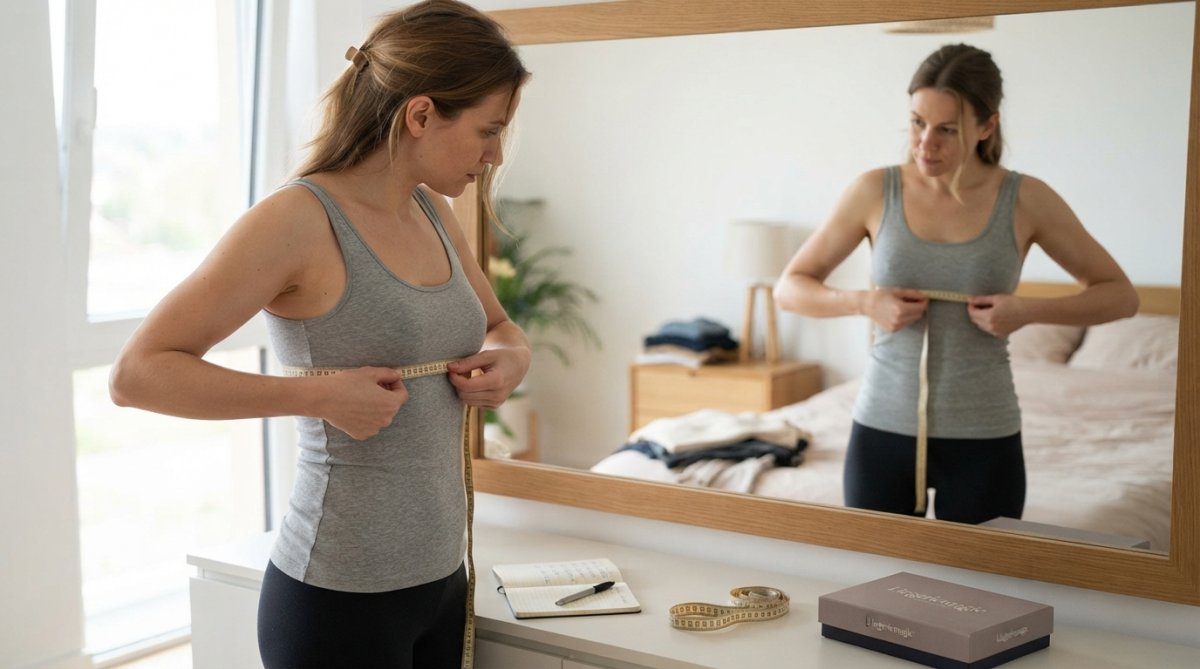
Follow these steps:
- Band size: Wrap the tape snugly around your ribcage, just under your bust. Round to the nearest whole number. If it is even, add 4 inches. If odd, add 5.
- Bust size: Wrap the tape around the fullest part of your bust, keeping it level. Do not pull tight.
- Cup size: Subtract your band number from your bust number. Each inch equals one cup size.
| Difference (inches) | Cup Size |
|---|---|
| 1 | A |
| 2 | B |
| 3 | C |
| 4 | D |
| 5 | DD/E |
| 6 | DDD/F |
How to Perform the Scoop and Swoop Method
The scoop and swoop method places all your breast tissue inside the cup where it belongs. It takes ten seconds and can change how any bra fits. Most people skip this step and wonder why their cups feel wrong.
Here is how to do it:
- Lean forward slightly and let your breasts fall into the cups.
- Slide your hand inside the cup, starting from the side.
- Scoop the tissue from under your arm toward the center.
- Swoop it up and into the cup.
- Adjust the wire so it sits under your breast, not on it.
- Repeat on the other side.
Frequently Asked Questions
My bra band fits, but my cup is too big. What should I do?
If the band feels snug but the cups have empty space or wrinkling, you likely need a smaller cup size. Try going down one cup letter while keeping the same band size (e.g., from a 34C to a 34B). If the band rides up or feels loose, adjust the band size first, then re-evaluate the cup. Remember that different bra styles, like plunge or full coverage, can fit differently even in the same size.
Why does my bra ride up in front when I lift my arms?
A bra that rides up in the front usually means the band is too loose. The band provides 80% of your bra's support, so if it's not snug, the whole bra shifts. Check if the band is on the loosest hook; as the elastic wears, you should move to tighter hooks. If the band still rides up, go down a band size and up a cup size (sister sizing) to maintain cup volume.
Is a bra supposed to be tight when you first buy it?
A new bra should feel snug on the loosest hook, not tight or painful. The band needs to be firm enough to stay in place, but you should be able to fit two fingers under the band comfortably. If it leaves red marks or restricts breathing, it's too tight. Over time, elastic relaxes slightly, so starting on the loosest hook allows you to tighten it as the bra ages.
Does bra size change over time?
Yes, bra size can change due to weight fluctuations, hormonal shifts, pregnancy, menopause, and aging. Breast tissue changes over time, affecting both band and cup size. It's wise to re-measure every six months or whenever you notice fit issues like digging straps or cup spillage. A well-fitting bra should adapt to your current shape, not your past size.
A bra that fits properly should feel comfortable from morning to night. If you are still adjusting, tugging, or readjusting, the size is wrong. Lingeriemagic offers a curated range of high-quality lingerie and intimate apparel built to last, with inclusive sizing for every body. Explore our collection to find bras that support you without compromise. Continue shopping with Lingeriemagic and discover everyday luxury that actually fits.
Related Posts

How to Find Accurate Bra Size Online: 2026 Fit Guide

Cosabella vs Bluebella: Lingerie Review 2026

Natural Alternatives to Chemical Fabric Softeners

Why Silk Lingerie Is Better for Your Skin: A 2026 Guide

How to Find Bra Size Without a Tape Measure

Tips for Buying Lingerie as Gifts: A 2026 Guide

How to Remove Stains from Silk Lingerie Safely
