

How to Find Accurate Bra Size Online: 2026 Fit Guide
Table of Contents
- Why Online Bra Sizing Goes Wrong (and How to Get It Right)
- What You Need Before You Measure
- How to Measure Bra Size at Home, Step by Step
- Using an Online Bra Size Calculator Without Getting Burned
- Why Calculator Results Differ (and Which Number to Trust)
- How Should a Bra Fit? A Complete Fit Check
- Sister Sizes Bra Guide: What to Do Between Sizes
- Brand Variation, International Sizing and Body Changes
- Frequently Asked Questions
Last Updated: October 18, 2026
Why Online Bra Sizing Goes Wrong (and How to Get It Right)
Most online bra size fails start with guessing: she orders the size she has always worn, the band rides up, and the return label follows, which is why an accurate bra size matters. Learning how to find accurate bra size online fixes that loop. This guide from Lingeriemagic covers the measuring steps, calculator traps, and fit check that confirms the number.
What You Need Before You Measure
You need a soft measuring tape, not a rigid ruler. A mirror keeps the tape level in back, and a note sheet keeps the numbers straight.
Choosing what to wear while measuring
Measure over naked breasts or a thin, non-padded bra. A padded or push-up bra adds volume that is not yours, and the cup size comes out too large.
An unlined bra works well if you prefer coverage. Wear the same style you plan to buy, since a molded cup and a lace bralette sit differently.

Stand tall with arms relaxed at your sides; do not hold your breath or pose.
How to position and hold a measuring tape
The tape must sit parallel to the ground all the way around. A tape that dips in back inflates the band number.
Hold the tape snug, not tight, you should slide one finger under it. Pulling hard compresses breast tissue and skews the bust measurement.
Read the number at eye level; looking down adds error.
How to Measure Bra Size at Home, Step by Step
The at-home method has three steps, each taking a minute or two. Do them in order, write each number down, and do not round mid-process.
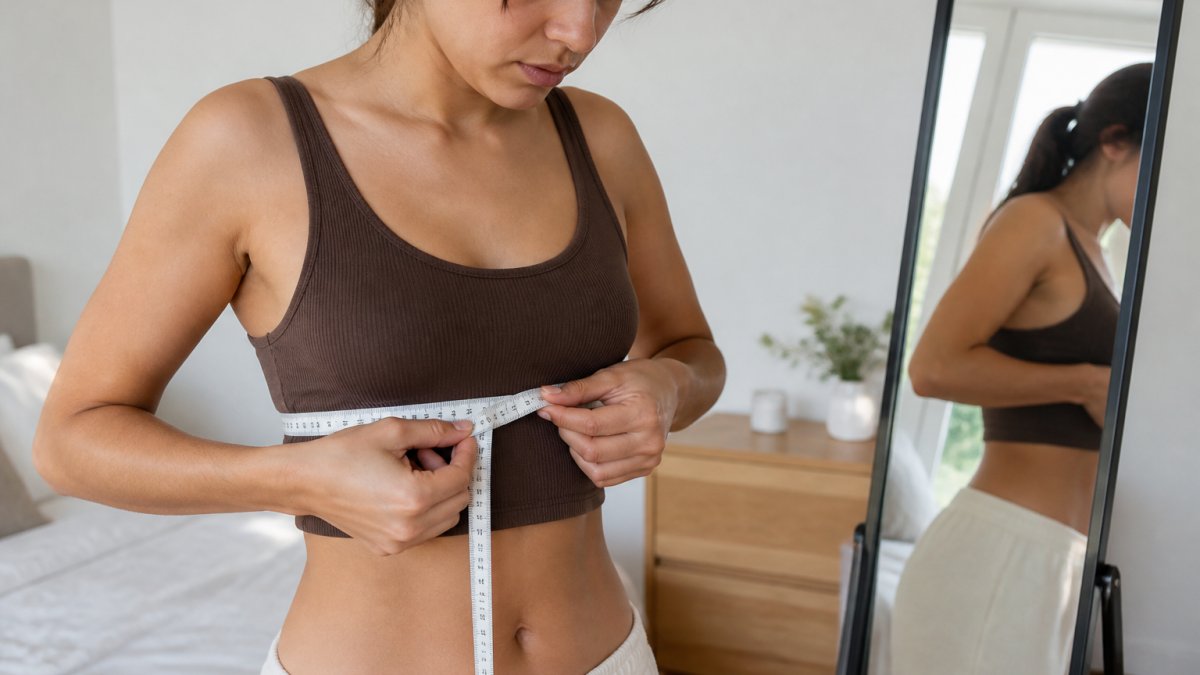
Step 1: Measure your band size
Wrap the tape around the rib cage directly under the bust, keep it level, exhale normally, and read the number in inches.
If the number is even, that is your band size. If it is odd, round down to the nearest even number.
Some sizing systems add four inches to the underbust instead, producing a looser band, that is why calculator results differ.
Step 2: Measure your bust at the fullest part
Loop the tape around the back and across the fullest part of the bust, level and snug, not tight.
Read to the nearest inch, noting any quarter inch, that detail matters when the result sits between sizes.
Standing and leaning measurements can differ slightly. Use the standing number as your base, and note any gap.
Step 3: Calculate cup size from the difference
Subtract the band number from the bust number. That measurement difference sets the cup size.
| Difference (inches) | Cup Size |
|---|---|
| 1 | A |
| 2 | B |
| 3 | C |
| 4 | D |
| 5 | DD / E |
| 6 | DDD / F |
| 7 | G |
| 8 | H |
A 34 band with a 38 bust gives a 4-inch difference, so the starting size is 34D. Treat that as a starting point, not a final verdict.
Using an Online Bra Size Calculator Without Getting Burned
An online bra size calculator is a fast shortcut, as long as you know what it is doing. Most tools take an underbust and a bust and run them through fixed rules. The rules, not your body, decide the output, learn them and you can predict when a calculator will steer you wrong.
What a calculator actually does with your numbers
Almost every calculator performs the same four operations, in this order:
- Band conversion. It takes your underbust and either keeps it snug (modern method) or adds four inches (the older "plus-four" method). This single choice can move you one full band size.
- Rounding. It rounds the band to the nearest even number, and rounds the bust to the nearest inch or half inch. Rounding up versus down can shift the cup by one letter.
- Cup subtraction. It subtracts band from bust and maps the difference to a letter using its own table. Tables differ: some call a 5-inch difference DD, others call it E.
- Regional relabeling. It converts the result into US, UK, EU, or FR letters. A US DDD and a UK E are the same cup volume under different names.
Because each step has at least two common conventions, two reputable calculators can return different sizes from identical measurements, both internally consistent. The disagreement is method, not measurement error.
How to feed a calculator correctly
- Use one unit throughout. Enter both numbers in inches or both in centimeters. Mixing units is the fastest route to a nonsense result.
- Answer the question asked. Some tools want the raw underbust; some want the band already rounded; some want a leaning bust rather than a standing one. Read the label on each field.
- Enter your own tape numbers, not a remembered size. A calculator fed a guessed band will confidently return a guessed cup.
How to sanity-check the result before you trust it
Run the output back through your own arithmetic. If the math does not reconcile, the tool used an unexpected convention, usually plus-four band sizing or a different rounding rule.
Then compare to a second calculator that states its method openly. When two transparent tools agree, confidence is high; when they disagree by one cup, the brand's own size chart breaks the tie.
Privacy: what you are handing over
A calculator asking for underbust and bust is asking for body measurements. Before you type them in:
- Check whether the site states what it stores and for how long. A plain privacy note is a good sign; silence is not.
- Prefer tools that compute in the browser and do not require an account.
- Avoid entering measurements alongside your name, email, or address unless you are actually placing an order.
Why Calculator Results Differ (and Which Number to Trust)
Two calculators can return different sizes from the same body, both "right" inside their own system. The gap comes from method, not wrong measurements.
The main sources of drift:
- Plus-four versus snug band. Older systems add inches to the underbust; modern ones do not.
- Rounding rules. Some tools round up, some round down, and some keep the quarter inch.
- Bust position. Standing, leaning, and lying measurements give slightly different numbers.
So which number do you trust? Trust your own tape first, then the calculator that matches the brand you are buying from. When the two disagree by one cup, try both if returns allow.
How Should a Bra Fit? A Complete Fit Check
A bra fits when the band stays put, the cups hold all breast tissue, and nothing digs or gapes. Run this check in front of a mirror before deciding a size is wrong.
- Band stays level. The band should not ride up in back. If it climbs, the band is too loose.
- Band is snug on the loosest hook. You should fit two fingers under it, no more.
- Center gore lies flat against the chest bone. A floating gore often means the cup is too small.
If the band passes but the cups fail, change the cup, not the band. If the band fails, change the band and recalculate the cup from the new number.
Sister Sizes Bra Guide: What to Do Between Sizes
Sister sizes are pairs of sizes holding the same cup volume on different band lengths, the fix for the in-between case.
The rule: go down one band size and up one cup letter, or up one band and down one cup.
Use sister sizing when the band is close but not right.
Do not use sister sizing to fix a cup that is clearly too small. Change the cup instead.
Asymmetry and between-size troubleshooting
Most women are not perfectly symmetrical, and one side often measures larger. Size to the larger side, then adjust the strap on the smaller side.
If you land exactly between two cup sizes, start with the larger cup.
For a band that sits between two numbers, choose the larger band and use a tighter hook.
Brand Variation, International Sizing and Body Changes
A size is a label, not a law. Brand variation means the same 34C fits differently across labels, since each brand cuts its own fit guide and size chart. International sizing adds another layer, and bodies change. Treat any calculator's number as a starting point to match to a specific brand's chart and recheck as your body shifts.
Why the same size fits differently across brands
Three things drive brand-to-brand variation:
- Band stretch. Some bands use firmer elastic and run tight; others relax quickly and run loose. A 34 from one label can behave like a 32 or a 36 from another.
- Cup construction. A molded cup holds its shape and runs shallow; an unlined lace cup conforms and runs deeper. The same letter can feel a full size apart.
- Grading rules. Brands scale cups differently as band size increases. A 34D and a 40D are not the same cup volume, and some labels grade more generously than others.
The practical habit: before ordering, open the brand's own size chart and compare its band and bust ranges to your tape numbers, not to the letter a calculator returned.
A careful international conversion guide
Size labels are not fully standardized across countries. The letters that matter most are the ones for larger cup volumes, where US and UK naming diverges.
| Difference (inches) | US label | UK label | EU band | FR band |
|---|---|---|---|---|
| 1 | A | A | 65-70 | 80-85 |
| 2 | B | B | 65-70 | 80-85 |
| 3 | C | C | 70-75 | 85-90 |
| 4 | D | D | 75-80 | 90-95 |
| 5 | DD | DD | 75-80 | 90-95 |
| 6 | DDD | E | 80-85 | 95-100 |
| 7 | G | F | 85-90 | 100-105 |
| 8 | H | FF | 90-95 | 105-110 |
Two cautions. First, EU and FR bands are usually given in centimeters and often use a different numbering convention than US inches, so convert your underbust before comparing.
When to remeasure
Bodies change, and a bra that fit two years ago may not fit now. That is normal, not a failure. Remeasure when any of these apply:
- Weight change. A shift of roughly 10 pounds or more is a common trigger to recheck band and cup.
- Pregnancy and breastfeeding. Band and bust can change repeatedly through pregnancy and settle differently after breastfeeding ends.
- Hormonal cycles. Some people notice a cup change across the month; measure on a consistent day if you track it.
A reasonable rhythm is to remeasure about once a year, and after any of the changes above.
Matching the number to a real chart
At Lingeriemagic, the inclusive size range and product size charts are built to make that remeasure easy, with personalized recommendation support when a size sits between two options. Shoppers can start with a lace bralette like the Avidlove Lace Bralette for a softer, adjustable fit while dialing in a structured size.
For a structured set with underwire support, the SOLY HUX Plus Size Lingerie Set in Dark Green lists its own product measurements, so the band and underbust numbers can be checked against a real chart rather than a guess.

Frequently Asked Questions
How accurate are online bra size calculators?
They are only as good as the numbers you feed them. A calculator that takes a snug underbust and a bust measurement at the fullest part will usually land within one size of a professional fitting, but results shift when you round differently or measure over a padded bra. Treat the output as a starting point, then confirm it with a fit check: the band should sit level and snug, the center gore should lie flat, and the cups should hold all breast tissue without gaping. If two of those fail, recalculate before you buy.
How tight should a bra band feel?
Snug enough that you can slide two fingers under the band at your back, and no more. The band does most of the support work, so a loose band lets the straps dig in and the back rides up. Measure your underbust with the tape pulled snug, parallel to the ground, and round to the nearest inch. If you land on an odd number, round down for a firmer fit or up if you prefer more give. Always fasten a new bra on the loosest hook so you have room to tighten it as the elastic relaxes.
What should I do if I fall between bra sizes?
Use sister sizes to bridge the gap. Going down one band size and up one cup size keeps roughly the same cup volume, so a 34C sister size is a 32D. Try the smaller band first if your current band rides up, and the larger band if you feel pressure on your rib cage. Asymmetry is common too: fit the larger breast and tighten the strap on the smaller side. If you are consistently between two sizes across brands, buy the one that fits the band correctly and adjust the cups.
Do bra sizes vary between brands and countries?
Yes, on both counts. A 34C from one label can feel like a 32D from another because cup volume and band stretch differ, and UK, US and EU sizing systems do not use the same cup letters past DD. Always check the brand's own size chart and read reviews for fit notes before ordering. Remeasure every six months or after any weight change, since band and bust measurements move together and a size that fit last year may no longer be accurate.
Finding an accurate bra size online comes down to three habits: measure snug and level, treat the calculator as a starting point, and confirm with a fit check. Lingeriemagic supports that process with a curated selection of quality lingerie, inclusive sizing across the range, and durable designs made for daily wear. Get started with Lingeriemagic and shop a size you can trust, with comfort that lasts beyond the first wash.
Related Posts

Cosabella vs Bluebella: Lingerie Review 2026

Natural Alternatives to Chemical Fabric Softeners

Why Silk Lingerie Is Better for Your Skin: A 2026 Guide

How to Find Bra Size Without a Tape Measure

Tips for Buying Lingerie as Gifts: A 2026 Guide

How to Remove Stains from Silk Lingerie Safely
