

Why Does My Lingerie Fall Apart? 2026 Care Guide
Table of Contents
- Why Heat and Tumble Drying Destroy Delicate Fibers
- Detergent Chemistry: How Harsh Formulas Break Down Fabric
- How to Wash Lace Lingerie by Hand Without Damage
- Lingerie Laundry Bag Benefits for Machine Washing
- How to Store Bras to Keep Shape and Structure
- Repair or Replace? Diagnosing Wear vs Poor Construction
- Frequently Asked Questions
Last Updated: October 1, 2026
Why Heat and Tumble Drying Destroy Delicate Fibers
Heat is the single biggest reason why does my lingerie fall apart faster than it should. Elastic fibers and delicate fabrics break down when exposed to high temperatures, and a tumble dryer turns that slow damage into a rapid one.
Here is what happens inside the drum. Elastic is made of polymer chains that stay springy only while they hold moisture and their natural coil. Heat pulls that moisture out and stiffens the chains. Every cycle stretches and relaxes them under stress, which is called fabric fatigue.
So the fix is simple: skip the dryer and let your pieces air dry.
How Elasticity Fades with Every Dryer Cycle
Elasticity fades because tumble drying combines three stressors at once: heat, agitation, and moisture loss. Elastic fibers rely on polymer chains that stretch and snap back. Heat weakens those chains, and the tumbling motion pulls them past their limit again and again.
A few cycles in, you notice the signs:
- Waistbands that no longer snap back
- Straps that feel loose or stretched out
- Cups that lost their shape
- Lace that looks tired and fuzzy
Air drying protects the fibers and keeps shape retention intact. It costs you nothing but a little patience.
Detergent Chemistry: How Harsh Formulas Break Down Fabric
Harsh detergent is the second quiet killer of delicate fibers, and the damage starts at the molecular level. Most mainstream detergents are engineered for cotton, towels, and workout gear. They rely on two things that are hostile to lingerie: a high pH (often 9-10.5) and enzymes like protease, amylase, and lipase. Protease breaks down protein-based stains, and silk, wool, and some lace blends are themselves protein fibers. Amylase attacks starches, which can include sizing and finishes on new garments. Lipase dissolves fats, including the natural oils that keep elastic fibers supple.
On silk, the alkaline pH alone is enough to dull the fiber's natural sheen and weaken its structure over repeated washes. On spandex and elastane, high pH accelerates hydrolysis, the same chemical reaction that makes old rubber bands brittle. On lace, whether nylon or cotton, enzyme residue left in the weave acts like a slow abrasive every time the garment moves against your skin.
Fabric breakdown shows up as thinning, dullness, and tiny holes that seem to appear from nowhere. The detergent does not care that your lace is delicate.
The fix is to match the chemistry to the fiber:
- Silk and wool blends: Use a pH-neutral or slightly acidic wash labeled for delicates or protein fibers. Avoid anything with protease.
- Spandex and elastane: Skip oxygen bleach (sodium percarbonate) and chlorine bleach entirely; both degrade elastic polymers.
- Lace and mesh (nylon/polyester): A mild liquid detergent without enzymes is enough. Powder detergents often leave undissolved grit that abrades fine weaves.
- Cotton lingerie: Slightly more forgiving, but still avoid hot water and high-pH formulas to preserve dye and shape.
A small capful is enough; more soap means more residue, not cleaner fabric. Residue is its own problem, it traps minerals, stiffens fibers, and can trigger skin irritation.
If you are unsure about your detergent, check the label for "pH neutral," "enzyme-free," or "wool-safe." Those three phrases are the quickest signal that a formula will not eat your lingerie alive.
How to Wash Lace Lingerie by Hand Without Damage
Learning how to wash lace lingerie by hand is the single best habit for making it last. It takes about five minutes and protects every delicate fiber in the garment.
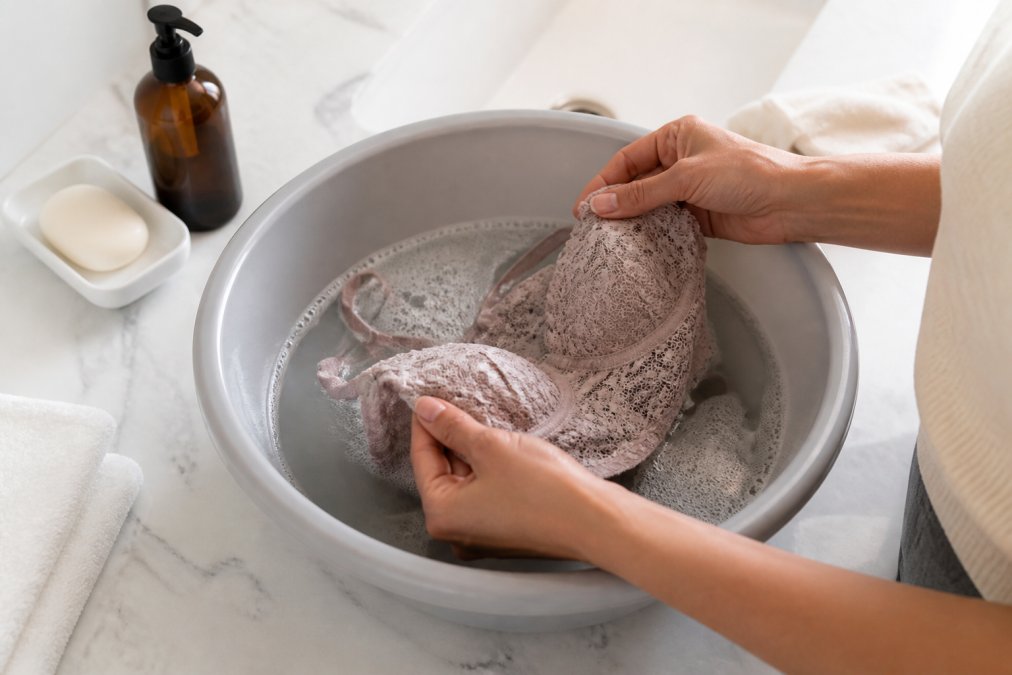
Follow these steps:
- Fill a clean bowl with cool water and a drop of mild detergent.
- Submerge the piece and let it soak for 5 to 10 minutes.
- Gently press the fabric with your palms. Never rub or wring.
- Rinse in cool water until the soap is gone.
- Press out water with a soft towel. Do not twist.
- Lay flat to air dry, reshaping cups and straps by hand.
Cold water keeps dyes bright and fibers strong. The gentle motion protects seam integrity and the hook and eye closures from bending.
Lingerie Laundry Bag Benefits for Machine Washing
A lingerie laundry bag is the difference between machine washing safely and machine washing destructively. It creates a protective barrier between your delicates and the drum, zippers, and buttons in the rest of the load.
The benefits stack up fast:
- Stops straps from tangling and stretching
- Shields lace and mesh from snags
- Keeps underwire from poking through fabric
- Prevents small items from getting lost
Use a mesh wash bag with a fine weave. Set your machine to the gentle cycle, cold water, and a low spin speed. Skip the dryer entirely and air dry flat.
How to Store Bras to Keep Shape and Structure
Knowing how to store bras to keep shape is just as important as knowing how to wash them. Bad storage flattens cups, bends underwire, and stretches straps even when the bra is clean and dry.
Store molded-cup bras stacked gently, one cup nested inside the other, in a drawer. Never fold a molded cup in half; the crease becomes permanent. Hang delicate lace pieces on padded hangers, or lay them flat in a drawer.
A few storage rules that protect shape:
- Keep drawers dry and out of direct sunlight
- Avoid cramming bras into tight spaces
- Rotate your everyday bras so no single one wears out fast
- Store sets together so matching pieces stay paired
Direct sunlight fades color and weakens elastic over time, so a closed drawer beats a sunny shelf.
Repair or Replace? Diagnosing Wear vs Poor Construction
Not every worn bra is a badly made bra. Learning to tell wear from poor construction saves you money and frustration. Some breakdown is normal aging. Some points to a real quality problem. And some damage is fixable in under five minutes.
Start with a simple diagnostic: when did the failure appear, and where?
| What You See | Likely Cause | Fixable? | What To Do |
|---|---|---|---|
| Stretched band after months | Normal fabric fatigue | No | Replace |
| Underwire poking out early | Poor construction or a bent wire | Sometimes | If the channel is intact, push the wire back and stitch the opening closed. If the channel is torn, replace. |
| Lace tearing at seams | Weak stitching or snag | Sometimes | Reinforce with a few hand stitches using matching thread. If the tear is in the lace itself, it will likely spread. |
| Hooks bending or snapping | Low-quality hardware | Yes | Replace the hook-and-eye closure with a repair kit; the rest of the bra may still have life. |
| Cups losing shape after weeks | Poor materials or heat damage | No | Replace |
| Straps slipping constantly | Stretched elastic or worn sliders | Sometimes | Replace the sliders or shorten the strap; if the elastic itself is stretched, replace. |
| Elastic waistband rolling | Heat damage or age | No | Replace |
A well-made bra should hold its shape through many gentle washes.
Material-specific repair notes:
- Lace: Small snags can be stopped with a tiny dot of clear nail polish or fray check on the back side. Do not use this on silk.
- Silk: Tears in silk rarely repair invisibly. A tailor can re-hem a seam, but a hole in the body of the fabric is usually the end.
- Mesh and powernet: These are the most repairable. A needle and matching thread can close a seam separation without showing.
- Molded cups: Once the foam creases, it does not recover. No repair will restore the smooth line under clothing.
Frequently Asked Questions
Why does lace underwear fall apart so quickly?
Lace is a delicate fiber with an open structure that snags easily and loses shape when exposed to heat or agitation. Tumble drying and harsh alkaline detergents accelerate fiber degradation, causing tears and loss of elasticity. Hand washing in cold water with a gentle detergent and air drying preserves lace construction far longer than machine washing on hot cycles.
Is it okay to put lingerie in the washing machine?
Yes, but only with precautions. Use a mesh laundry bag to prevent snagging, select a cold water cycle with low spin speed, and choose a gentle or delicate setting. Never wash lingerie with heavy items like jeans or towels. Enzyme-based detergents designed for delicates can be effective. Machine washing this way is safer than hand washing incorrectly, but hand washing remains the gentlest option for lace and silk.
How often should you replace your bras and underwear?
Bras typically last six to twelve months with regular wear and proper care. Underwear may need replacing every six to nine months depending on fabric quality and wash frequency. Signs it is time to replace include stretched bands, poking underwire, lost elasticity, and visible fabric thinning. Rotating several bras and following correct lingerie care routines extends their usable life significantly.
Why do bra wires poke out after a few washes?
Underwire pokes through when the casing fabric weakens from repeated agitation, heat exposure, or alkaline detergents that degrade fibers. Machine washing without a lingerie laundry bag allows the wire to twist and rub against the casing. Once the casing tears, repair is difficult and replacement is usually necessary. Preventing this starts with cold water hand washing or using a wash bag on a gentle cycle.
Your lingerie should not fall apart after a few washes. The culprits are almost always heat, harsh detergent, and rough handling, and each one has a simple fix. Lingeriemagic offers a curated selection of high-quality lingerie and sleepwear built to last, with durable designs, inclusive sizing, and everyday comfort in mind. Get started with Lingeriemagic and give your favorite pieces the long, beautiful life they deserve.
Durable Lingerie Brands for Daily Wear: 2026 Guide
Inclusive Sizing Lingerie Brand Guide: 2026 Fit Tips
Related Posts

Why Silk Lingerie Is Better for Your Skin: A 2026 Guide

How to Find Bra Size Without a Tape Measure

Tips for Buying Lingerie as Gifts: A 2026 Guide

How to Remove Stains from Silk Lingerie Safely

Is Wireless Lingerie Worth It for Everyday Wear?

Sister Sizing Guide for Beginners Explained

Bare Necessities vs Journelle: Which Retailer Fits You
