

Durable Lingerie Brands for Daily Wear: 2026 Guide
Table of Contents
- What Makes Lingerie Durable Enough for Daily Wear
- Quick Comparison: Durable Lingerie Brands for Daily Wear
- Best Everyday Bras for Comfort and Support
- Durable Cotton Underwear Brands Worth Trying
- How to Wash Delicate Lingerie So It Lasts Longer
- Price-Per-Wear: Why Durable Lingerie Costs Less Over Time
- Frequently Asked Questions
Last Updated: September 30, 2026
What Makes Lingerie Durable Enough for Daily Wear
Durable lingerie is intimate apparel built to survive repeated washing, wearing, and stretching without losing its shape, support, or softness. The difference comes down to three things: fiber quality, construction method, and how you care for it. At Lingeriemagic, we've built our curated selection around exactly those three factors, because everyday luxury only means something if the pieces are still comfortable and durable.
Fiber: why staple length matters more than the label
The single biggest predictor of how a fabric ages is staple length, the average length of the individual fibers spun into the yarn. Long-staple fibers (Pima and Supima cotton, extra-long-staple Egyptian cotton, Tencel lyocell, and high-grade modal) twist together with fewer exposed ends, so they resist pilling and thinning at friction points like underarms, waistbands, and strap adjusters. Short-staple cotton and recycled cotton blends feel soft on day one but shed fibers quickly, which is why budget underwear goes thin and fuzzy within a season.
Construction: the seams you can't see decide the lifespan
Three construction details separate a bra that lasts two years from one that lasts six months:
- Stitched vs. bonded seams. Bonded (glued) edges look seamless and disappear under clothing, but the adhesive degrades with heat and detergent. Double-stitched or zigzag-stitched seams flex with the fabric instead of cracking.
- Encased vs. exposed elastic. Elastic that is folded inside a fabric channel is protected from detergent and friction. Exposed elastic on a band or strap edge is the first thing to fray.
- Hardware material. Metal hooks, sliders, and rings resist bending and hold their finish; plastic equivalents crack at the stress points, usually at the strap-to-cup junction.
Fit: the hidden durability variable
A bra that fits correctly distributes tension across the band, straps, and cups. A bra that doesn't forces one component to carry the load, and that component fails first. A too-loose band makes the straps do the work, stretching them out. A too-tight band stresses the hook-and-eye closure. A cup that's too small pushes the underwire into the fabric, wearing a hole at the gore.
The certification shortcut
The OEKO-TEX textile certification standards give a useful benchmark here, since certified fabrics have been tested for both chemical safety and durability under repeated washing. GOTS certification, meanwhile, tells you the cotton is organic and the supply chain is tracked, which is a reasonable proxy for fiber quality even though it doesn't directly measure longevity.
Quick Comparison: Durable Lingerie Brands for Daily Wear
The table below summarizes the brands covered in this guide, what each does best, and where each falls short. Use it to shortlist before reading the detailed sections.
| Brand | Starting Price | Standout Strength | Best For | Main Trade-Off |
|---|---|---|---|---|
| Lingeriemagic | Varies by style | Curated quality, inclusive sizing, designed to last | Women wanting everyday comfort plus occasion pieces | Online-only browsing |
| Pact | $15 | GOTS-certified organic cotton | Affordable eco-friendly basics | Few lace or fashion styles |
| Organic Basics | $18 | Tencel and odor-control treatment | Minimalists wanting longevity | Higher than mass-market cotton |
| CUUP | $20 | Breathable power mesh support | Unlined, barely-there comfort | No heavy padding options |
| Nudea | $30 | Fit precision and recycled materials | Shoppers who prioritize fit | Mid-to-high pricing |
| Skims | $18 | Extensive size and color range | Seamless everyday wear | Frequent stock shortages |
| Montelle Intimates | $25 | Durable lace, larger cup support | Lace lovers and fuller cups | Traditional aesthetic |
| Hanes | $10 | Multi-pack value | Budget basics | Limited style appeal |
| Quince | $12 | Silk and organic cotton value | Luxury fibers at lower cost | No try-on retail presence |
Best Everyday Bras for Comfort and Support
The best everyday bras balance support with breathability, and the deciding factor is usually the band, not the cup. A wide, reinforced band carries most of the weight, taking pressure off your shoulders and keeping straps from digging in by mid-afternoon.
Durable Cotton Underwear Brands Worth Trying
Cotton remains the most breathable, skin-friendly fiber for daily underwear, and the durable versions share one trait: long-staple fibers that resist pilling. Short-staple cotton feels soft initially but breaks down fast at friction points.
How to Wash Delicate Lingerie So It Lasts Longer
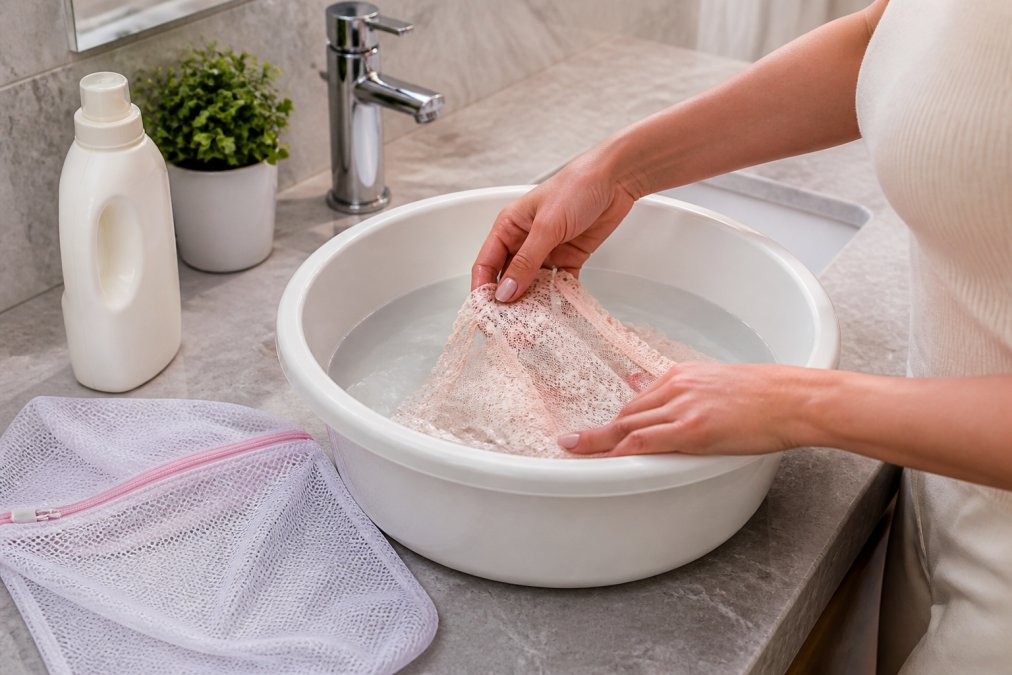
Hand washing in cool water with a gentle detergent is the single most effective way to extend lingerie life. Heat and agitation destroy elastic, and both are avoidable. But the routine changes depending on the garment's fiber, and most care guides skip that part. Here is the fiber-by-fiber version.
The universal hand-wash routine
- Fill a basin with cool water (below 30°C / 86°F) and add a capful of gentle detergent. Avoid bleach, enzymes, or fabric softener; softener coats elastic and reduces its snap-back.
- Submerge and soak for 10-15 minutes. Don't scrub; let the detergent work.
- Gently squeeze the suds through the fabric. Never wring or twist, which stretches elastic.
- Rinse in cool water until no suds remain.
- Press water out with a towel. Lay flat to dry, reshaping the cups and band as you go.
- Never tumble dry. Heat is the fastest way to kill a bra's elasticity.
Fiber-specific adjustments
- Cotton and Tencel: The most forgiving. Cool machine wash on delicate is usually fine, but cotton benefits from a slightly warmer rinse to prevent detergent residue, which can stiffen the fabric over time.
- Silk: Hand wash only, with a pH-neutral detergent. Silk loses strength when wet, so support the garment rather than letting it hang. Never wring.
- Lace and mesh: Hand wash or mesh bag only. Lace snags on zippers, hooks, and even other lace, so wash lace items separately or in their own bag.
- Spandex-heavy pieces (sports bras, seamless underwear): Chlorine and hot water are the two biggest threats. Rinse immediately after swimming or sweating, and never leave them soaking.
Storage matters as much as washing
A bra that is washed correctly but stored badly will still deform. The rules that matter most:
- Never fold cups into each other. Stacking one cup inside another crushes the underwire and stretches the band. Store bras upright in a drawer, cups nested side by side, or hang them by the band.
- Keep hooks fastened. An open hook snags lace and mesh in the drawer the same way it does in the wash.
- Rotate, don't stack. People who get years out of their bras typically run a three-to-five bra rotation, with each bra resting at least 24 hours between wears so the elastic can recover.
When to machine wash anyway
If hand washing isn't realistic every time, machine washing on a cold, delicate cycle in a mesh bag is a reasonable compromise. Fasten hooks first, close any zippers on other items, and wash lingerie with other delicates rather than towels or denim, which abrade the fabric. Skip the dryer entirely; air drying on a flat rack adds years to a bra's life.
Price-Per-Wear: Why Durable Lingerie Costs Less Over Time
Price-per-wear is the cost of a garment divided by the number of times you actually wear it. A cheaper piece that falls apart after a few months usually costs more per wear than a better-made one that lasts years.
A quick way to apply this:
- Estimate how often you'll wear the piece per week.
- Assume a durable garment lasts at least twice as long as a cheap one.
- Divide the price by estimated total wears.
- Compare that number, not the sticker price.
Frequently Asked Questions
What fabric makes lingerie the most durable for daily wear?
Cotton blends, modal, and Tencel tend to hold up best through repeated washing. Organic cotton with a small amount of elastane keeps its shape without sagging. Lace made from nylon blends with reinforced stitching also lasts well when cared for properly. Avoid 100% silk for everyday rotation since it snags and stretches faster. Look for GOTS-certified organic cotton or high-quality power mesh if you want fabric that survives dozens of wash cycles without pilling or losing stretch.
How can you tell if a lingerie brand is high quality?
Check the stitching first. Reinforced seams, flatlock construction, and clean finishing signal a brand that expects its pieces to last. Look for details like wider straps, sturdy hook-and-eye closures, and fabric that springs back when stretched. Certifications such as GOTS or Fair Trade also indicate ethical production standards. Brands that publish detailed sizing guides and fabric composition information are usually more transparent about quality than ones that only show styled photos.
How often should you replace your everyday lingerie?
Well-made everyday bras typically last 6 to 12 months with regular wear, depending on how many you rotate. Underwear lasts longer, often 12 to 18 months, if the elastic stays intact and the fabric does not thin. Signs it is time to replace: stretched bands, broken underwires, pilling, or straps that no longer stay adjusted. Rotating at least 5 to 7 bras and 10 or more pairs of underwear extends the life of each piece significantly.
Which lingerie brands offer the best balance of comfort and durability?
Brands that prioritize fabric quality and fit tend to score highest. Lingeriemagic focuses on durable designs with inclusive sizing and everyday comfort. Pact uses GOTS-certified organic cotton that holds up wash after wash. CUUP builds bras from breathable power mesh engineered for support without heavy padding. Montelle Intimates is known for lace that survives daily rotation. The right pick depends on whether you want minimalist basics, supportive bras, or lace pieces that still feel comfortable.
What are the best care tips to make lingerie last longer?
Hand-wash delicate pieces in cool water with a gentle detergent, or use a mesh laundry bag on a delicate cycle. Never put lingerie in the dryer. Heat breaks down elastic and warps underwires. Air-dry flat or hang by the band, not the straps. Rotate your everyday pieces so no single bra gets worn two days in a row. Store bras stacked, not folded in half, to keep cups from creasing. These habits can double the lifespan of well-made lingerie.
Best Lingerie for 36DDD Sizes: A 2026 Fitting Guide
Why Does My Lingerie Fall Apart? 2026 Care Guide
Related Posts

Why Silk Lingerie Is Better for Your Skin: A 2026 Guide

How to Find Bra Size Without a Tape Measure

Tips for Buying Lingerie as Gifts: A 2026 Guide

How to Remove Stains from Silk Lingerie Safely

Is Wireless Lingerie Worth It for Everyday Wear?

Sister Sizing Guide for Beginners Explained

Bare Necessities vs Journelle: Which Retailer Fits You
